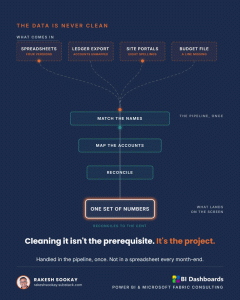

You think spreadsheets are free? Here’s the price tag.
We’ve all heard the argument: “Excel works.” Sure, it does. Right up until it doesn’t.
In our work with businesses scaling from R500 million to R10 billion in Assets Under Management, one pattern repeats: reporting systems that feel free but operate on invisible debt. Debt in the form of duplicated effort, late decisions, data distrust, and morale decay.
Let’s unpack the real cost of manual reporting, not in theory, but in context of companies that want to scale fast, but can’t afford friction.
1. Time Isn’t Just Money. It’s Momentum.
Every month, asset managers in one group reassemble the same Excel-PowerPoint combo: exports, reformatting, commentary, cross-checking. It takes hours. Worse? The moment the data hits the boardroom, it’s already outdated.
That lost time isn’t just operational overhead. It’s the space where smarter decisions could have happened. When every rep is racing to hit sales targets, stale numbers aren’t just inefficient, they’re damaging.
2. Broken Trust: When Numbers Don’t Line Up
One executive told me, “If I go into a meeting and two teams show different versions of the same report, I stop trusting both.”
And that’s the thing: Excel doesn’t just allow flexibility, it allows fiction. With no source-based validation, it trusts whatever’s typed in. I’ve seen staff fabricate sales data just to hit bonus triggers. Not out of malice, but out of a broken system.
Worse still? When files are duplicated across stores via Dropbox, someone will use the wrong version. And when they do, the data war begins.
3. Cultural Cost: From Analysts to Admin Clerks
Ask any data analyst how they feel about rebuilding broken Excel sheets. These aren’t analysts anymore. They’re firefighters. And their flame? A misaligned formula in a spreadsheet no one truly understands.
Over time, this kills morale. Teams stop asking better questions and start justifying bad data. Collaboration shifts from curiosity to CYA (cover your assumptions).
4. Manual Input = Manual Errors = Missed Margins
Restaurants, especially those running thin profit margins, can’t afford to miscount cash. But when data is manually downloaded, adjusted in Excel, and interpreted differently per store? You’re not just losing time, you’re risking fraud.
Standardisation across stores? Nonexistent. Different logic. Different rules. No unified version of truth. And when data from another POS comes in? Now you’re duplicating work across two POS systems because someone didn’t plan integration properly.
5. Automation Is Not the Goal. Confidence Is.
One client said it best: “I want to open one screen, show the CFO dashboard, go get coffee, and be done.”
That’s not laziness. That’s clarity. Real automation doesn’t just save time. It builds confidence. It standardises logic, removes tampering risk, and gives executives something they don’t have with Excel: accountability.
That only happens when reporting becomes a product, not an afterthought. Scoped. Prioritised. Maintained. Supported.
So What Can You Do About It?
Start here:
- Prioritise pain. What reports break most often? Which ones create the most confusion?
- Scope and sequence. Not everything needs to be fixed now. Start with high-impact, repeatable reports.
- Introduce SLAs. If your dashboards go down, who fixes them? Who owns support?
- Plan integration upfront. If you’re running multiple POS or ERP systems, build for scale.
- Transfer skills. If the person who built your dashboard gets hit by a bus, can someone else carry on?
Manual reporting isn’t just a nuisance. It’s a threat to decision velocity, data integrity, and business trust.
And the fix? It’s not just a tool.
It’s a mindset shift.
Takeaway
You can duct-tape your Excel setup for another quarter. Maybe even another year. But at some point, your growth will demand clarity, consistency, and control.
That’s when you stop building reports.
And start building reporting systems.
Who am I? I’m Rakesh Sookay, founder of BI Dashboards. With over 15 years of experience in data, analytics, and corporate reporting, I help businesses turn scattered information into meaningful insight. I’m a Microsoft Certified Power BI Data Analyst and have spent my career bridging the gap between technical complexity and executive clarity. I blend data expertise with business acumen, and a genuine drive to simplify the path to better decisions. You can reach us on LinkedIn, or schedule an intro call via info@bidashboards.co.za.